Tested unit by unit before packing
Gas Torch Quality Control: 20+ Tests per Unit
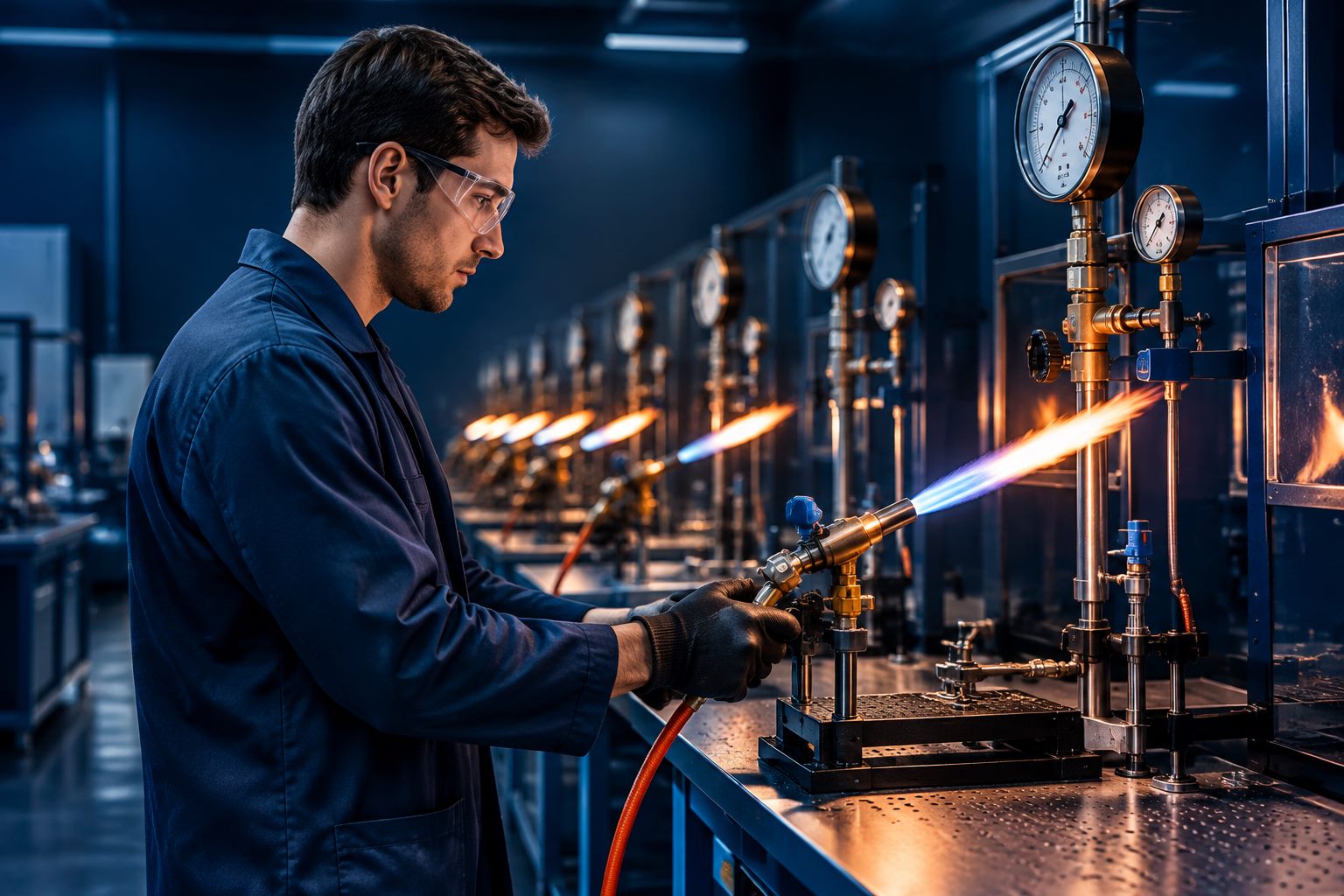
A butane torch is a pressure vessel with a live flame at the end of it, so quality control is not a department here — it is the production process itself. Every unit that leaves our Wenzhou factory passes more than 20 factory test items before it is packed. Four of those checks are the ones buyers ask about by name: air-tightness, ignition, pressure and backfire. Together they verify that the torch holds gas without leaking, lights when it should, contains working pressure and never lets the flame strike back into the body.
Testing is organized in three stages. Incoming materials are inspected before they enter production; checks continue on the line as assemblies move through stations, supported by an AI-based inspection system; and finished, packed goods are checked again before release. The whole workflow runs under ERP control, so test records follow the order — which matters when your customer service team needs to answer a question two years after shipment.
The system is backed by external references: the factory operates under ISO 9001, the product line holds a GB/T 38522-2020 national standard test report dated December 2025, and the category is aligned with the ISO 9994 and ISO 22702 safety specifications. Development runs jointly with university labs, and the same engineering group stands behind the 100+ patents the company holds.
Professional tool, not a toy: read the manual before use and keep away from children. Fuel canisters are not included — purchase them locally according to your local regulations.
Professional tool, not a toy. Read the manual before use. Keep away from children. Fuel canister not included — purchase locally per local regulations.
Per-unit test routine
What the 20+ factory tests cover
More than 20 test items run on every unit before packing. The named checks confirmed in our test routine are air-tightness, ignition, pressure and backfire; the full routine is organized into the five dimensions below, from gas path to packed carton.
| Dimension | What is verified | Named checks in this routine |
|---|---|---|
| Sealing & pressure | The gas path holds fuel without leaking: joints, valve seats and seals stay gas-tight, and the body contains working pressure. The 304 stainless steel bite joint sealed with HTXC1700 silicone (rated 1000°C+) is the construction this dimension protects. | Air-tightness test; pressure test |
| Ignition performance | The electronic ignition lights reliably and repeatedly, consistent with the 5,000+ ignitions the system is rated for, across the -30°C to 30°C operating range. | Ignition test |
| Flame stability | The flame burns steady and wind-resistant, adjusts cleanly with the control knob, and shuts off as designed — including the valve-linked auto shut-off that cuts gas supply when the flame goes out. | Backfire test |
| Materials & workmanship | Body materials match the model specification — aviation-grade heat-resistant ABS shell with 304 stainless steel, brass and aluminum parts by model — and assembly meets the build standard before the unit moves downstream. | Covered by the per-unit routine and in-process checks |
| Finished product & packing | Final appearance, accessories and labeling are complete, the manual matches the ordered language, and cartons leave the line intact and ready for export loading. | Covered at the pre-shipment stage |
Rated figures such as the ~1300°C flame temperature and the ~50 cm flame length (±10 cm with altitude, pressure and temperature) are factory-rated values under standard test conditions. Triple protection — flame-out protection, over-pressure protection and backfire prevention — is built into every model in the line.
QC process
Three inspection stages, one ERP record
Quality control runs at three points in the process. Each stage has a defined purpose, and results stay attached to the order in the ERP system rather than in a separate drawer.
| Stage | Point in the process | Purpose |
|---|---|---|
| Incoming inspection | Before materials and components enter production | Valves, ignition components, seals, body materials and other gas-path parts are checked against specification, so defects are stopped at the gate instead of assembled into product. |
| In-process inspection | On the production line, station by station | Assemblies are checked as they move through the line, and an AI-based inspection system runs alongside manual checks as an additional automated layer — catching deviations while the unit can still be corrected. |
| Pre-shipment inspection | After packing, before release | Finished, packed goods are checked once more — per-unit test completion, appearance, accessories and carton condition — before the order is released for shipment. |
ERP-attached records
Inspection results follow the order in the ERP system from incoming materials to released cartons, keeping the quality trail with the shipment, not in a side file.
AI inspection on the line
The AI-based inspection system adds an automated check layer to in-process control, complementing the manual test bench rather than replacing it.
University joint R&D
Development runs jointly with university labs, so inspection methods evolve with the product — the same pipeline behind the company's 100+ patents.
About the factoryStandards & reports
External references behind the routine
Internal tests are anchored to external standards and an official report. These are the references an import buyer can quote when registering the product in a market or answering a regulator.
GB/T 38522-2020 report
The product line holds a test report against GB/T 38522-2020, the applicable Chinese national standard for this product category, dated December 2025.
ISO 9001 quality management
The factory operates under ISO 9001, the international quality-management standard that structures how processes, records and corrective actions are managed.
ISO 9994 & ISO 22702 alignment
The category is aligned with the ISO 9994 lighter and ISO 22702 utility-lighter safety specifications, which cover flame height, flame extinguishing, drop resistance and related requirements (scope per ISO 9994:2018 and ISO 22702:2018).
Full certification wallFor the United States market, multi-purpose lighters are additionally subject to child-resistance requirements under 16 CFR 1212 (per eCFR, the official US federal regulations text). Our export team works to the certificate and documentation set each destination market expects — tell us the market in your RFQ.
Why it matters
What this means for your first order
For an importer, a factory test routine is only useful if it survives contact with your process. Ours is designed to plug into the three moments that decide your risk: sampling, production and the container. At sampling you receive a unit built on the same line and tested by the same routine as volume production, so what you approve is what you get. During production, the three-stage inspection plus the ERP record mean questions can be answered while the order is still in the building. At shipment, the 20+ item routine and the released-carton check are the last filter before your goods leave our control.
If your channel requires documented quality for onboarding — marketplace category approval, retail vendor audits or tender files — start from the certifications page, where certificates are mapped model by model, and request the documentation set with your RFQ. For custom orders, the same routine applies: your logo goes on a product that has already passed the line, not on a shortcut around it.
Professional tool, not a toy. Read the manual before use. Keep away from children. Fuel canisters are not included — purchase them locally according to your local regulations.
FAQ
Quality questions buyers ask
Which tests does every unit pass before packing?
Every unit passes more than 20 factory test items before packing. The confirmed named checks include air-tightness, ignition, pressure and backfire tests; the routine as a whole covers sealing and pressure, ignition performance, flame stability, materials and workmanship, and finished-product packing.
Is there an official test report for the products?
Yes. The product line holds a GB/T 38522-2020 national standard test report dated December 2025, alongside CE certificates covering GF-8010, GF-8011 and GF-8016 valid to 2028 and TÜV, UL, CPSC and SGS certification records. See the certifications page for the model-by-model table.
What standards does the factory operate under?
The factory operates under ISO 9001 quality management, and the product category is aligned with the ISO 9994 and ISO 22702 lighter and utility-lighter safety specifications, which cover flame height, flame extinguishing, drop resistance and related safety requirements (scope per ISO 9994:2018 and ISO 22702:2018).
What does the AI inspection system do?
An AI-based inspection system runs on the production line as an additional automated check layer alongside manual inspection. It supports the in-process quality control stage; joint development with university labs feeds both the product line and the inspection system.
How should a gas torch be used safely?
It is a professional tool, not a toy. Read the manual before use, keep it away from children, operate in a ventilated area and never point the flame at people, animals or flammable goods. Fuel canisters are not included — purchase them locally according to your local regulations.
Want the test documentation with your quote?
Tell us your model and market — we reply with specifications, pricing, lead time and the certificate set that applies.